The fastest and most reliable way to get rid of mice is to set multiple snap traps in the right locations, bait them with peanut butter, and check them daily. Do not use just one or two traps. Mice travel the same routes and the more traps you have on those routes, the faster you clear the population. At the same time, seal every gap of 6mm or more, because a mouse can push through a hole the size of a pencil.
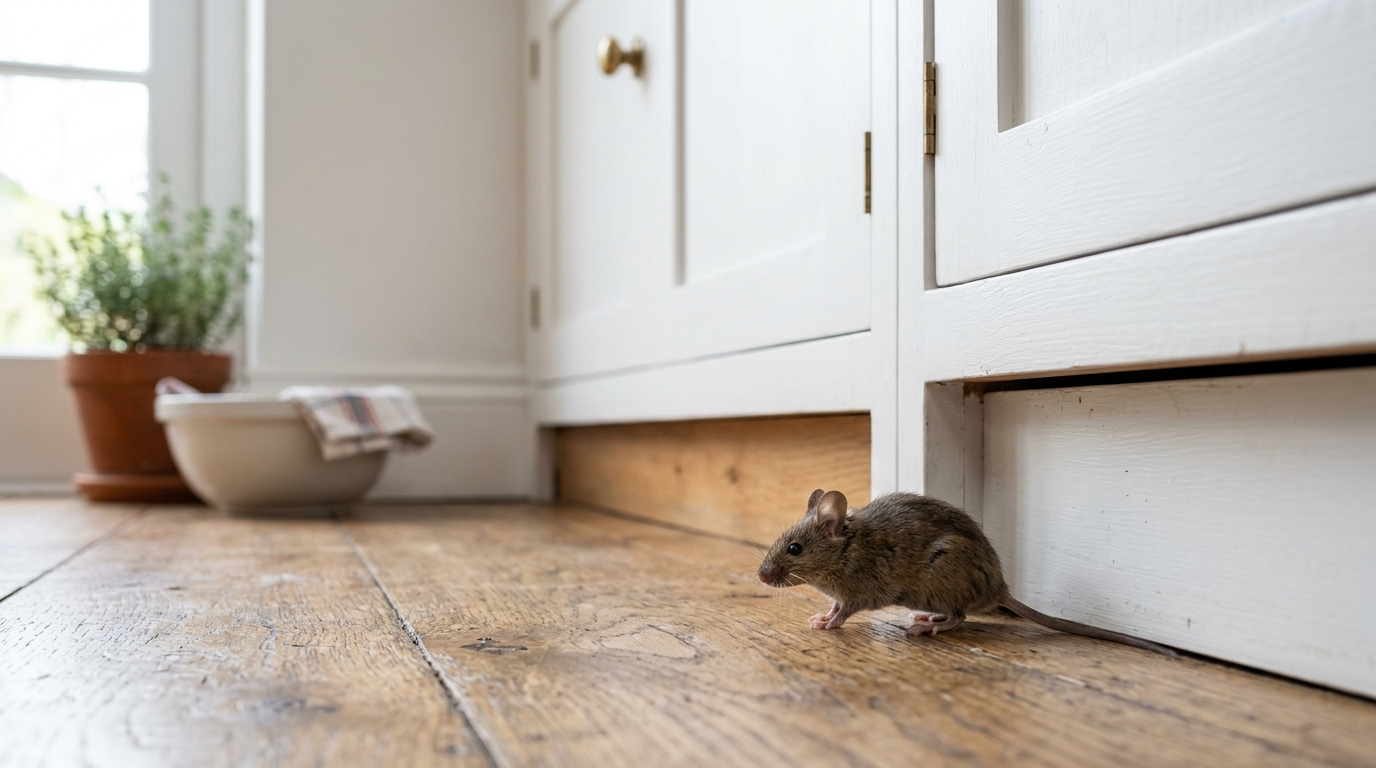
How do mice get into your house?
A mouse needs only a 6mm gap to enter, which is roughly the diameter of a pencil. This makes proofing a property genuinely difficult, because gaps that small are easy to miss. The most common entry points are gaps around pipework under kitchen units, holes in cavity walls where the inner and outer leaf separate, gaps under doors (especially back and side doors), and poorly fitted utility cupboards where pipes enter from outside.
Mice are also excellent climbers. They can run up a vertical brick wall and enter through gaps in rooflines, around window frames, and through airbricks. In terraced properties and flats, they move between units through shared cavities. If your neighbour treats their mouse problem, the mice often just move next door.
Food is the primary draw. Mice follow scent trails and will squeeze through almost any gap if they can detect food on the other side. Keep food in sealed containers, including pet food, and remove any sources of accessible water.
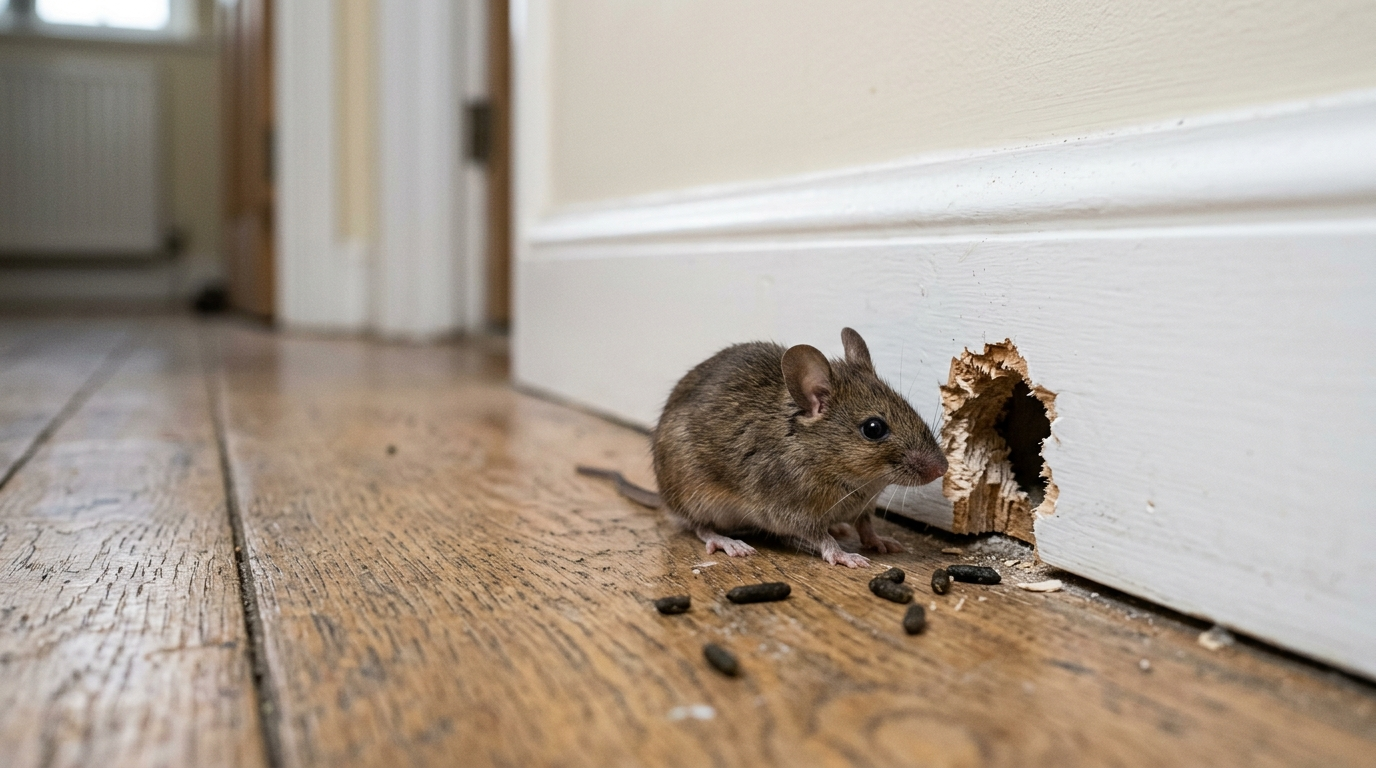
House mouse or field mouse? How to tell the difference
It helps to know which mouse you are dealing with, because it tells you where they are coming from.
 Field mouse (wood mouse)
This is the one that lives outside in gardens, fields, hedgerows and sheds, and comes indoors when it turns cold. You tell it apart by its eyes and ears, which are big, and its colour, a warm sandy brown on top with a clean white belly. It is a proper jumper with big back feet. If these are getting in, they are coming from outside, so the job is finding and sealing the gaps they use, usually in garages, sheds, lofts and around the edges of the house.
 House mouse
This is the classic indoor mouse that lives in the house all year round and breeds inside. It is a duller, more even grey-brown all over, with smaller eyes and ears than a field mouse, and a tail about as long as its body. The giveaway is often the smell, a musty whiff where they are nesting, along with small dark droppings. These live in the wall cavities, under units and in the loft, so the job is trapping where they run and sealing their gaps indoors.
What is the best product for mice?
A good quality snap trap is the most effective tool for mice. It kills instantly, is reusable, and means you know where the body is. Look for a break-back style trap with a wide, sensitive treadle plate. The cheap plastic versions from the pound shop are unreliable because the spring is weak and the treadle is too stiff. A mouse can take the bait without setting them off.
You will need more traps than you think. For a typical kitchen infestation, I start with six to eight traps positioned in pairs along the back of units, along skirtings, and behind the washing machine. Doubling up in one location increases your chances significantly.
As an Amazon Associate I earn from qualifying purchases.
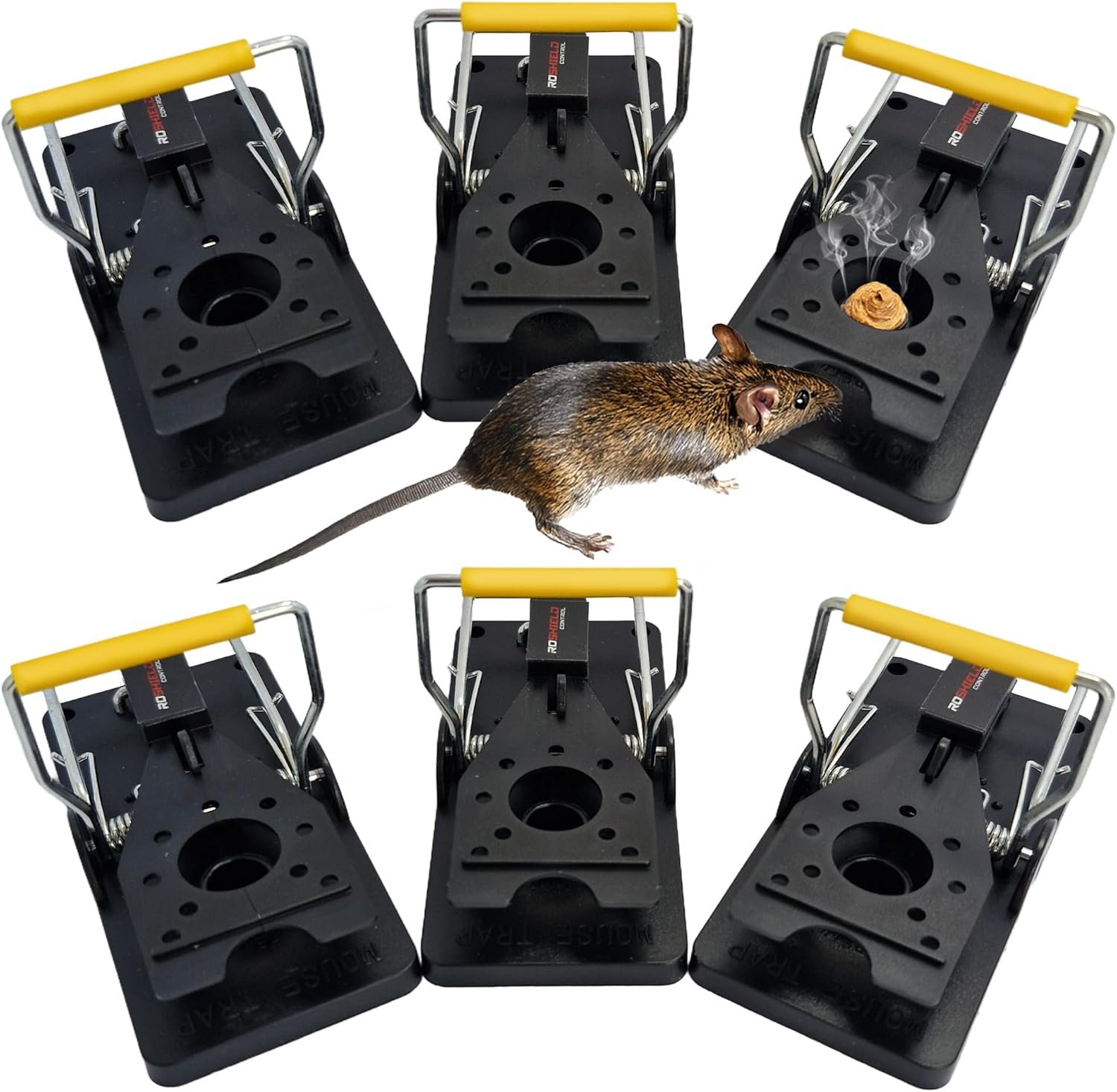
What to look for: a yellow bar mouse trap with a yellow plastic bait bar and a strong spring. Buy them in multi-packs of 6 or more. The yellow bar versions outperform the cheap plain plastic ones. For bait, mix a few seeds of bird seed into a little peanut butter and press it into the cup on the bait bar. The peanut butter holds the seed in place and makes the mouse work at it, so it sets the trap off properly. Mice love it, and you only need a small amount.
Check price on AmazonBuy at least 6 to 8 traps for an average kitchen infestation. More is always better than fewer.
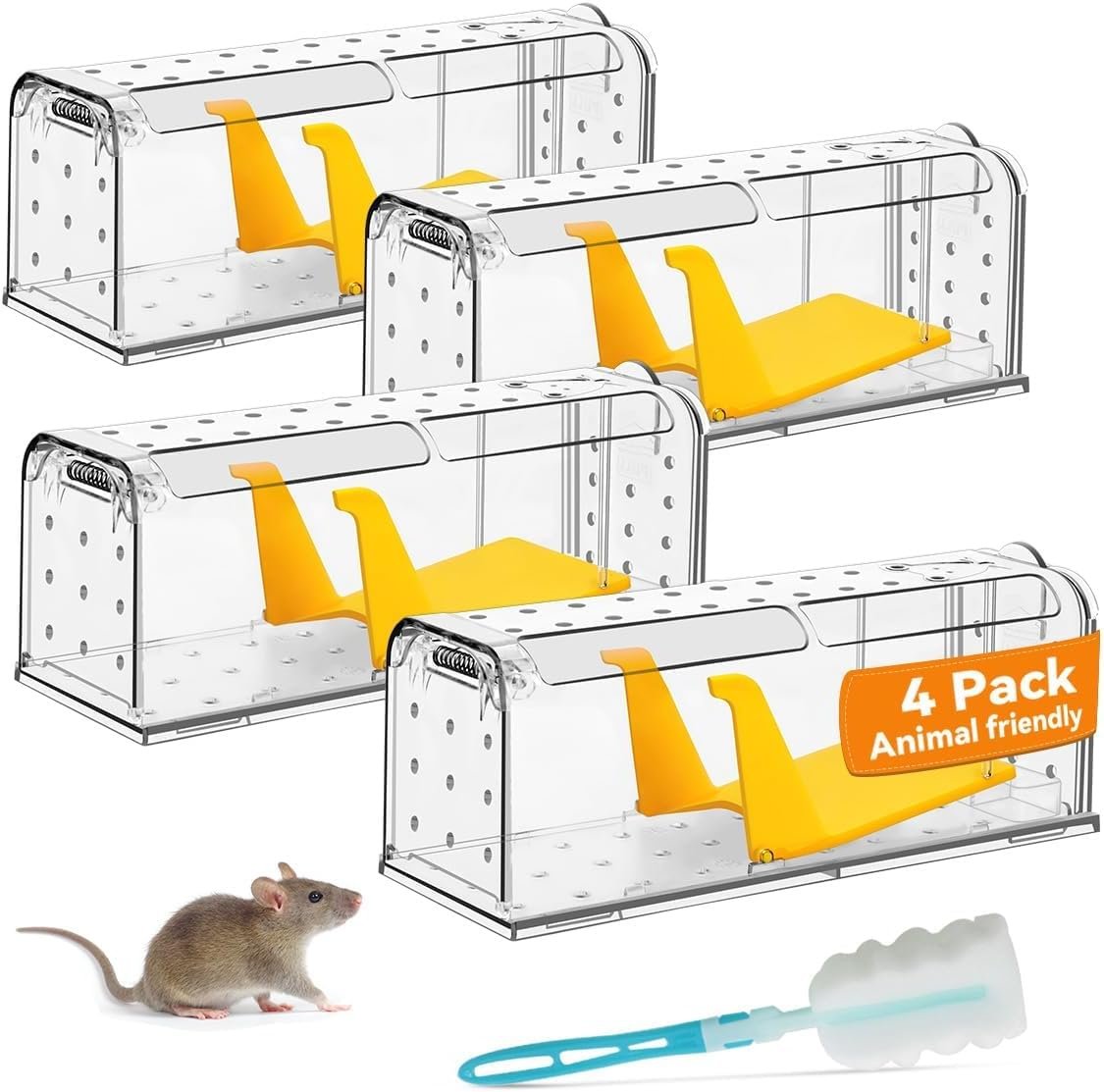
What I use: a humane mouse trap. This is the catch-and-release type. The mouse walks in after the bait, a door shuts behind it, and it is caught alive and unharmed so you can let it go. Good if you would rather not kill them. For bait, bird seed beats everything. Mice love it, and a few seeds at the far end draws them right in. Set the traps along the walls where the mice run, not out in the open, and check them often, at least morning and night, because a trapped mouse cannot be left in there long. Let it go well away from the house, a good distance off, or it will simply come back in.
Check price on AmazonAs an Amazon Associate I earn from qualifying purchases.
What to avoid
These are one of the most widely sold and most useless products in pest control. I have seen mice nesting in a kitchen drawer two feet from a plugged-in ultrasonic device. There is no solid evidence they work in a real domestic setting. Do not spend money on them.
People buy a couple of traps, catch one mouse, and think the job is done. Then they hear scratching again three weeks later. Mice travel in family groups and a single trap catches one individual. You need enough traps on enough runs to deplete the population quickly before they learn to avoid them.
Glue boards catch mice but do not kill them. A live mouse on a glue board is distressing for the animal and for whoever has to deal with it. In England, Wales, and Scotland, you have a duty under the Animal Welfare Act not to cause unnecessary suffering. Unless you can check the boards very frequently, I would not recommend them for domestic use.
How to use it properly
Place traps along walls with the treadle end facing the wall, not pointing outward. Mice run along the edge of rooms and walls. A trap placed in the middle of the floor rarely catches anything. The ideal spot is behind appliances, inside cupboards, and along any run where you can see droppings or smear marks.
Bait the treadle with a pea-sized amount of peanut butter or hazelnut chocolate spread. Avoid using a large piece of food that can be dragged off without setting the trap. Check every trap every day. A mouse in a trap that is left for several days will deter others from the same area.
Once catches drop to zero and there are no fresh droppings or gnaw marks for five to seven days, the active infestation is cleared. Then focus on proofing to stop re-entry.
When to call a professional
Call a pest controller if:
- You have been trapping for two to three weeks and catches are not declining
- Activity is in roof spaces, cavity walls, or underfloor voids that are inaccessible
- You cannot find or reach the entry points to proof them
- The property is a food business or rented accommodation where a quick resolution is legally important
- You are catching mice but new ones appear almost immediately, suggesting entry from a shared space such as a neighbouring property or communal area
Frequently asked questions
Seeing one mouse in daylight usually means there are more. Mice are nocturnal and bold enough to appear during the day only when a population is large or competition for food is high. A breeding pair can produce up to 60 offspring in a year, so catching one quickly matters.
Peanut butter is excellent because it sticks to the treadle and mice cannot steal it without triggering the trap. Hazelnut chocolate spread works equally well. Use a pea-sized amount. Avoid large pieces of hard food like cheese or biscuit that can be removed cleanly.
No. A mouse inside a warm home with access to food and water has no reason to leave voluntarily. They breed rapidly and an untreated problem grows significantly over weeks. Act as soon as you see signs.
Mice can squeeze through a gap of 6mm, roughly the diameter of a pencil. Any gap larger than that needs sealing with wire mesh, metal kick plates, or mortar. Expanding foam alone is not enough as mice can chew through it.
No, not in practice. I have visited homes with multiple ultrasonic devices plugged in and active mouse infestations in the same rooms. Save the money and spend it on more snap traps.